I have become suddenly semi-literate; for a month, my partner and I have been traversing Costa Rica, and although the guidebooks say “most people in Costa Rica speak English” we find this largely untrue. I know a little bit of Spanish—I took it in high school, but that was, uh, some time ago. This sudden onset of illiteracy has been a great learning experience. For instance, Hemingway’s “bullshit detector,” as he calls his demand for precise, true language and nothing else—nothing namby-pamby or fatuous, nothing baroque or decorated in any way—is of imminent importance for us as I listen to people respond to my questions. Of course, my own questions have been indubitably pared down to terse toddler-like demands. “I would like decaf coffee,” believe it or not, is out of the question. Our Spanish phrase book, first published in 1959 and apparently not updated for the 1994 version, contains handy translations for “I would like to buy a dozen hankerchiefs and a cigar case” or “I want a roll of movie film for this camera” but it does not contain the translation for “decaf coffee” or “ I am allergic to…wheat.” Neither does our Spanish-English dictionary, which proclaims itself to be “the most up-to-date dictionary of its kind.” Although we have the translations for “Is there an English speaking priest here?” and “No, I do not want my tooth extracted, can you fix it temporarily?” we, thank the traveling Gods, have not had to use them.
So, we wander the countryside without future tense, or past tense, and we find ourselves forced to practice the important lesson Harvard professor-turned-mystic, Ram Dass became famous for: BE HERE NOW. Without the language for the philosophic, our attention stays in the moment, at the level of verb & noun. But the philosophic level of the mother tongue and the survival-oriented crash course level of the newly acquired language are both equally important and satisfying.
When we go about life in our own comfortable niche, following the safe “predictable” (or so we think) schedule of our everyday lives, we tend to forget that nothing is assured. In many ways, this is a mindgame: I can just as easily be utterly astonished when I leave my home in Port Angeles, Washington and make it the mile up the road, through a stand of woods, and down a cliff-side trail to end up on a desolate beach as I do here, where we leave the house, catch a taxi, a bus, and end up on a desolate beach. But the astonishment inherent here is great, because I have no expectations that my final desired destination is a given. It makes me incredibly grateful for the language I have, however limited or half-forgotten my Spanish lexicon happens to be. Our “routine” and our mother-tongue is only as predictable as we make it. The main difference with being unfettered as travelers is that suddenly, understanding the bus driver’s growling response feel as weighty as enlightenment. Well, besides that, on occasion, you look up from a hammock and see monkeys in the coconut palms.
H.K.H
Thursday, July 13, 2006


Wednesday, July 05, 2006
The Quickening
I am keenly interested in the moment an idea quickens and begins to form into a piece of writing; one may be at a dinner party discussing wine or the World Cup, the latest Survivor episode or the symphony—who knows what nonsense, when the attention begins pulling inward, towards the stirrings of something readying for composition. It seems almost impossible to articulate the sensation of a poem trying to form; the sensation is visceral, surely. Things fall away and lose importance as the writer awakens to what begins to shape. It doesn’t take much to create that first impetuous inspiration, does it? Perhaps your attention, like mine, gets snagged on the lithesome curve of a fern frond, the surprisingly robust, broad and serrated outline of a banana leaf, or the startling spicy tang of an exotic fruit. But one might look at those things, or uncountable others, before something strikes, just right, just exactly so, and a chord resonates.
In the tropics, I find the muse is just as much an elusive tease as in the Pacific Northwest, but, equally compelling when located. What is the key? Traveling thousands of miles to some languid equatorial countryside? Yes, definitely. But perhaps too, it is the pace with which we move. Zen Buddhists use walking meditations as a path towards enlightenment. The mindful movement balances the effort of focusing with the body’s need for fluidity—sitting too long makes the brain and the body stagnate, as any office worker or student knows. It is probably not coincidental that so many avid walkers are writers—think of the famous writers of the Lake District—the Wordsworths, the Shelleys and Lord Byron. Colin Fletcher wrote a fantastic contemplation of geologic time while wandering naked (except for his boots) through the Grand Canyon.
Besides slowing down enough to hear our poems and stories, there is another element to completing the circuitry of art. Jack Kornfield puts it well when he notes, “The painter George Braque once exhorted those around him, ‘It’s up to us to be real strong eccentrics and not to waver.’ Eccentricity means uniqueness, finding the freedom to be utterly one’s own person. Even if outwardly we do not appear different, inwardly there is the fearless ability to be wholly the embodiment of yourself” (After the Ecstasy, the Laundry 212). So, a bit weird and a tad (selectively) deaf to the outside world, we can hear the unheard and bring it forth.
H.K.H.
In the tropics, I find the muse is just as much an elusive tease as in the Pacific Northwest, but, equally compelling when located. What is the key? Traveling thousands of miles to some languid equatorial countryside? Yes, definitely. But perhaps too, it is the pace with which we move. Zen Buddhists use walking meditations as a path towards enlightenment. The mindful movement balances the effort of focusing with the body’s need for fluidity—sitting too long makes the brain and the body stagnate, as any office worker or student knows. It is probably not coincidental that so many avid walkers are writers—think of the famous writers of the Lake District—the Wordsworths, the Shelleys and Lord Byron. Colin Fletcher wrote a fantastic contemplation of geologic time while wandering naked (except for his boots) through the Grand Canyon.
Besides slowing down enough to hear our poems and stories, there is another element to completing the circuitry of art. Jack Kornfield puts it well when he notes, “The painter George Braque once exhorted those around him, ‘It’s up to us to be real strong eccentrics and not to waver.’ Eccentricity means uniqueness, finding the freedom to be utterly one’s own person. Even if outwardly we do not appear different, inwardly there is the fearless ability to be wholly the embodiment of yourself” (After the Ecstasy, the Laundry 212). So, a bit weird and a tad (selectively) deaf to the outside world, we can hear the unheard and bring it forth.
H.K.H.
Sunday, June 18, 2006
Editor's Note
Volume 1.2 of Blood Orange Review is now available.
17th century haiku poet Chigetsu has a poem that seems similar to how I felt while compiling the new issue of Blood Orange Review:
Bush warbler: I rest my hands in the kitchen sink.
Often, we move through our day forcefully--rushing, pushing, and working to finish everything we need to finish. But the submissions that arrived in my mailbox over the last month were like Chigetsu's birdsong; they made me pause and listen.
Leave the dishes in the sink: they won't go anywhere.
H.K.H
Friday, June 16, 2006
Creative Writing Prompt #5
At a Christmas party this year, I received an intriguing party favor--a diamond shaped thing about the size of a walnut labeled "Princess Towel." The instructions simply said "sprinkle with warm water." A few seconds later, the thing blossomed open into a normal-sized washcloth decorated with Sleeping Beauty's demurely smiling face. There was something strangely entertaining and tricky about that party favor--the slightly vague labeling piques a child's (or even admittedly, an adult's) curiosity, the semi-magical unfolding fills little girls with tremulous anticipation as they wonder what it will be when it finishes opening up, and then, the let down: it is a washcloth, something you use to clean behind your ears--how more disappointingly "useful" can you get?
This semi-magical princess towel reminds me of a short poem. Short poems can be surprising, intriguing, and funny. They can be deceptively obscure or deceptively simple. Sometimes, short poems, like the zen koans that Buddhist teachers give to their students to "solve," can leave the student a tiny bit more enlightened.
Marvin Bell said, "A short poem need not be small."
Consider A.R. Ammons' poem, "Coward":
Bravery runs in my family.
Or David R. Slavitt's one word poem:
Motherless.
Or Buson's haiku:
Violets have grown here and there
on the ruins of my burned house.
Even with a stringent economy of words, the poems tumble forth and open kaleidoscopically. There are different techniques poets use for a short poem:
1. juxtaposing two unexpected or paradoxical things
2. building on an image that elicits an emotional impact
3. arranging words in a way that shifts or emphasizes an unexpected meaning
Most of all, the short poem requires playfulness. Give it a shot.
This semi-magical princess towel reminds me of a short poem. Short poems can be surprising, intriguing, and funny. They can be deceptively obscure or deceptively simple. Sometimes, short poems, like the zen koans that Buddhist teachers give to their students to "solve," can leave the student a tiny bit more enlightened.
Marvin Bell said, "A short poem need not be small."
Consider A.R. Ammons' poem, "Coward":
Bravery runs in my family.
Or David R. Slavitt's one word poem:
Motherless.
Or Buson's haiku:
Violets have grown here and there
on the ruins of my burned house.
Even with a stringent economy of words, the poems tumble forth and open kaleidoscopically. There are different techniques poets use for a short poem:
1. juxtaposing two unexpected or paradoxical things
2. building on an image that elicits an emotional impact
3. arranging words in a way that shifts or emphasizes an unexpected meaning
Most of all, the short poem requires playfulness. Give it a shot.
Sunday, June 04, 2006
Where in the world is Blood Orange Review?
Since our inaugural issue in April, Blood Orange Review has welcomed visitors from all over. We're very excited that the work we're featuring is finding readers far and wide. On this map, nearly every state in the union has found their way to us -- come on, now, Alabama!

Our international visitors (not shown here) include Korea, Belgium, Costa Rica, Japan, Ireland, Switzerland, England, and others.
You won't want to miss our next issue, which is truly outstanding. The expected publication date is mid-June. If you'd like to receive email notification of its arrival, go here.
Our international visitors (not shown here) include Korea, Belgium, Costa Rica, Japan, Ireland, Switzerland, England, and others.
You won't want to miss our next issue, which is truly outstanding. The expected publication date is mid-June. If you'd like to receive email notification of its arrival, go here.
Wednesday, May 31, 2006
Creative Writing Prompt #4
A few days ago, National Public Radio reported that a delivery truck, which was carrying a popular brand of potato chips, was stolen. When the truck was recovered a short time later, twenty-two bags of potato chips had already been eaten.
Imagine the overwhelming feeling (hunger? desire? Insatiable whatever it was!) that overtook him. That is passion! That chip thief's furious feast depicts a moment of human/animal wildness that fills us with an upwelling of unstoppable song.
Mary Oliver writes about such moments. Consider her poem, "Honey At The Table":
It fills you with the soft
essence of vanished flowers, it becomes
a trickle sharp as a hair that you follow
from the honey pot over the table
and out the door and over the ground,and all the while it thickens,
grows deeper and wilder, edged
with pine boughs and wet boulders,
pawprints of bobcat and bear, until
deep in the forest you
shuffle up some tree, you rip the bark,
you float into and swallow the dripping combs,
bits of the tree, crushed bees - - - a taste
composed of everything lost, in which everything lost is found.
Describe the thing that makes you uncontrollably wild. Perhaps, you too are inspired by twinkies, ho ho's or potato chips; perhaps (hopefully) you are enraptured by something with less hydrogenated fats. In any case, whatever wakes the animal-hunger in you is most likely an intrguing poem waiting to happen.
Imagine the overwhelming feeling (hunger? desire? Insatiable whatever it was!) that overtook him. That is passion! That chip thief's furious feast depicts a moment of human/animal wildness that fills us with an upwelling of unstoppable song.
Mary Oliver writes about such moments. Consider her poem, "Honey At The Table":
It fills you with the soft
essence of vanished flowers, it becomes
a trickle sharp as a hair that you follow
from the honey pot over the table
and out the door and over the ground,and all the while it thickens,
grows deeper and wilder, edged
with pine boughs and wet boulders,
pawprints of bobcat and bear, until
deep in the forest you
shuffle up some tree, you rip the bark,
you float into and swallow the dripping combs,
bits of the tree, crushed bees - - - a taste
composed of everything lost, in which everything lost is found.
Describe the thing that makes you uncontrollably wild. Perhaps, you too are inspired by twinkies, ho ho's or potato chips; perhaps (hopefully) you are enraptured by something with less hydrogenated fats. In any case, whatever wakes the animal-hunger in you is most likely an intrguing poem waiting to happen.
Thursday, May 25, 2006
Creative Writing Prompt #3
Writers are not the most practical of people. I often find myself reading essays or listening to discussions about being "productive," or doing something because it is "useful" or promotes "progress;" these words, as usually defined, are a bit alien to my daily lexicon. For instance, most writers I know would consider a "productive" day one spent staring at a blank wall in contemplative revelry. "Usefulness" can be interpreted in equally confounding ways: my grandma uses the elastic waistbands from 30-year-old BVDs to hold boxes closed. While he was a student, my partner worked each morning helping a retired farmer complete great feats of usefulness: he would spend hours on end making twine balls with miscellaneous pieces of twine. Re-using and recycling is honorable; however, considering the farmer was paying him, the ball of twine probably cost 10 times what it did at the local hardware store by the time he finished tying it.
Study an implicit code that you or someone you know lives by. Notice the differences in the way an abstraction like "progress" or "good" or "beautiful" can be defined. This topic has the potential for humor, as well as a new glimpse at the broad variations of our human understanding of value.
H.K.
Study an implicit code that you or someone you know lives by. Notice the differences in the way an abstraction like "progress" or "good" or "beautiful" can be defined. This topic has the potential for humor, as well as a new glimpse at the broad variations of our human understanding of value.
H.K.
Saturday, May 20, 2006
What's In It For Me?
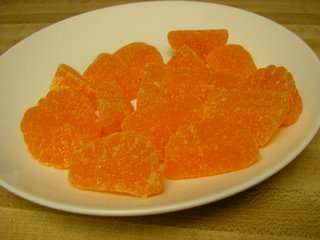 There have been two or three publishing agreements waiting for me each day when I return home from work, and it's been great fun seeing our next issue gradually coming together.
One contributor sent these orange slices along with the agreement, and I must say it was a sweet surprise. I'm pretty sure Heather's health-conscious diet doesn't include allotments for items with modified food starch, yellow#6 and red#40. So these sucrose-laden babies are all for me.
I want to make it clear, lest foetry.com gets a whiff of this: I do not take bribes. I will not publish the work of just anyone who sends me sugar. But I admit I'm always looking to new writing for what it can give me. I want to walk away from a story knowing something different about how people think and act and work. Ellen Bryant Voigt once explained to me that stories show us all the ways we're different and poems show us all the ways we're alike. Yes, teach me that.
I've eaten a few too many of these tonight, and I probably won't be able to sleep. Good writing does that to me too. That's why I love doing this. That's why I hope you'll keep reading. I'm excited about our forthcoming writers. Stay tuned. Let us surprise you.
Stephanie
Thursday, May 18, 2006
Creative Prompt #2
Sometimes it is helpful to look at the world upside down. This week, Scientologists revealed some of their tools for building "super powers" of perception. Some of the tools included an anti-gravity simulator and a gyroscope. Yoga practitioners do inversions--headstands, handstands, shoulderstands--to facilitate balance in the body systems and energy levels. Babies and children love to swing upside down. One of the first things students learn in art class is to look at something and then draw it upside down; the exercise challenges you to look and see (really see) the lines and angles of something as it IS instead of as you expect it to be. Flipping your world around can not only feel good (think back to the last time you rolled down a grassy hill: bliss, pure and simple) but it can also enhance your powers of perception and make you see things in a new, more vivid way.
Try to turn your world upside down; it doesn't have to include gyroscopes or a trapeze--maybe straying from your normal routine and sitting on a beach somewhere is enough. If you're lucky, a poem or story is lurking underneath the experience; watch (really watch) and notice the lines, angles, various shades and tones of the experience, and then tug the poem or story to the surface.
Try to turn your world upside down; it doesn't have to include gyroscopes or a trapeze--maybe straying from your normal routine and sitting on a beach somewhere is enough. If you're lucky, a poem or story is lurking underneath the experience; watch (really watch) and notice the lines, angles, various shades and tones of the experience, and then tug the poem or story to the surface.
Monday, May 01, 2006
Attention Artists and Photographers
Blood Orange Review is currently seeking artwork and photography for the upcoming issue. Please submit your art. Send artwork as an email attachment (jpeg format, preferably) to submissions@bloodorangereview.com.
Sunday, April 30, 2006
Creative Prompt #1 : Making the Political Personal
We promised to occasionally post writing prompts to spark your creative interest. If you have good ideas for a writing prompt, email me and let me know. In the meantime...
Yesterday at the Burning Word Festival on Whidbey Island Carolyn Kizer was honored with the Washington Poets Association Lifetime Achievement Award. The person who introduced her quoted someone (forgive my vague citation) that said Carolyn Kizer succeeded so well with her poetry because she refused to make a distinction between the personal and the political.
Find your personal/political voice and shape it into something powerful.
Yesterday at the Burning Word Festival on Whidbey Island Carolyn Kizer was honored with the Washington Poets Association Lifetime Achievement Award. The person who introduced her quoted someone (forgive my vague citation) that said Carolyn Kizer succeeded so well with her poetry because she refused to make a distinction between the personal and the political.
Find your personal/political voice and shape it into something powerful.
Sunday, April 23, 2006
Blood Orange Review Issue 1.1
It is our pleasure to announce the new issue of Blood Orange Review. To view it, please go to: http://www.bloodorangereview.com/.
Our interest in literature is, thank goodness, a fickle thing. Of course, the power to engage us waxes and wanes (long stretches of craggy-cliff rimmed beaches distract us, as do the endearing peccadilloes of our loved ones and our pets). But, in addition, the kinds of writing we are compelled to read change dramatically from day to day. Sometimes I need the absurd. Other times, it is the ineluctable, curious feel of a mouthful of words; try rolling this bit of a Ted Kooser poem around for a moment: "very dirty panties." Albeit, a bit of a soiled image, but disregarding that, the feel of the assonance, the internal rhymes and slant rhymes are a thoroughly successful visceral experience.
Compiling this issue of Blood Orange Review has introduced me to a variety of writings comprised of intriguing, thoughtful, funny moments. I read some of these pieces months ago. However, I continue to spontaneously recall moments of them as they slip into my consciousness, again and again: Jayne Stahl's bird, for instance, and Derrick Knowles’ one-eyed moose, or Tom Fitzpatrick's befuddled boy on a bus. Maybe a moment in the April issue of Blood Orange Review will stay with you too, dogging along during your daily wanderings. Or perhaps, there will be a combination of words, like Kooser's oddly perfect "very dirty panties" that will roll around scraping and sliding just right, like a handful of river-rounded pebbles.
Heather Hummel, co-editor
How appropriate that Heather would mention ass-onance in conjunction with Kooser’s line “very dirty panties.” Good writing works on so many levels!
The kind of writing I love is something more than “word noise,” as another poet friend calls it. It’s more than a pretty image or the revelation of an interesting event. The writing I love simultaneously gives and withholds: it needs the reader to complete the circuit.
Yes, our interest in literature is fickle, but I have to believe it matters. Why else extend the offer if we don’t believe it’s worth taking?
So, please, take this gift. Read Sally Albiso’s poem to find out about the woman who swallowed her cell phone. Read Molly Meneely’s gem, Pas de Deux. Dive into Andrea Dilley’s photograph, featured on our site. It’s worth it.
Stephanie Lenox, co-editor
Our interest in literature is, thank goodness, a fickle thing. Of course, the power to engage us waxes and wanes (long stretches of craggy-cliff rimmed beaches distract us, as do the endearing peccadilloes of our loved ones and our pets). But, in addition, the kinds of writing we are compelled to read change dramatically from day to day. Sometimes I need the absurd. Other times, it is the ineluctable, curious feel of a mouthful of words; try rolling this bit of a Ted Kooser poem around for a moment: "very dirty panties." Albeit, a bit of a soiled image, but disregarding that, the feel of the assonance, the internal rhymes and slant rhymes are a thoroughly successful visceral experience.
Compiling this issue of Blood Orange Review has introduced me to a variety of writings comprised of intriguing, thoughtful, funny moments. I read some of these pieces months ago. However, I continue to spontaneously recall moments of them as they slip into my consciousness, again and again: Jayne Stahl's bird, for instance, and Derrick Knowles’ one-eyed moose, or Tom Fitzpatrick's befuddled boy on a bus. Maybe a moment in the April issue of Blood Orange Review will stay with you too, dogging along during your daily wanderings. Or perhaps, there will be a combination of words, like Kooser's oddly perfect "very dirty panties" that will roll around scraping and sliding just right, like a handful of river-rounded pebbles.
Heather Hummel, co-editor
How appropriate that Heather would mention ass-onance in conjunction with Kooser’s line “very dirty panties.” Good writing works on so many levels!
The kind of writing I love is something more than “word noise,” as another poet friend calls it. It’s more than a pretty image or the revelation of an interesting event. The writing I love simultaneously gives and withholds: it needs the reader to complete the circuit.
Yes, our interest in literature is fickle, but I have to believe it matters. Why else extend the offer if we don’t believe it’s worth taking?
So, please, take this gift. Read Sally Albiso’s poem to find out about the woman who swallowed her cell phone. Read Molly Meneely’s gem, Pas de Deux. Dive into Andrea Dilley’s photograph, featured on our site. It’s worth it.
Stephanie Lenox, co-editor
Friday, April 07, 2006
Fencing the Conversation
I'll tell you what I've been thinking about lately: mud minnows, skunk cabbage, and the blogs of Iranian feminists. I've been thinking about my students, and how I can challenge them this quarter to think about the spectrum of gender. And I've been perseverating on (three) guitar chords. All of these things will probably show up in my poetry in the next couple of weeks; it is stirring me enough to show up in my writing (it is here with me now, as I work on Blood Orange Review, obviously).
Language is a slippery thing.
I have to admit: I love language and I hate it; language never completely does its job of getting at exactly everything we want it to verbalize. But, then, sometimes, despite the pitfalls, it still does wonders. The creation of Blood Orange Review means that we, as the creators, must define it. But I don't know that either Stephanie or I are quite comfortable with that yet; there is a simple reason why: any thoughtful human being with "control" of a forum for communication should be strongly aware of what needs talking about and not shy away from it.
Noam Chomsky stated in Distorted Morality that we are all hypocrites and if we don't admit we are hypocrites then we must be leveling a willful refusal to acknowledge truth. Hmm. Is it impossible to be thoughtful and a-political? Does a journal that is self-defined as "startling" fail if it is not startling in every-which-way possible? Can we maintain a happy balance of provoking and enjoyable?
What are you contemplating? What is stirring you enough to put into a poem, an essay? Offer it up: infiltrate our thoughts.
Waiting,
H. K. Hummel
co-editor
Language is a slippery thing.
I have to admit: I love language and I hate it; language never completely does its job of getting at exactly everything we want it to verbalize. But, then, sometimes, despite the pitfalls, it still does wonders. The creation of Blood Orange Review means that we, as the creators, must define it. But I don't know that either Stephanie or I are quite comfortable with that yet; there is a simple reason why: any thoughtful human being with "control" of a forum for communication should be strongly aware of what needs talking about and not shy away from it.
Noam Chomsky stated in Distorted Morality that we are all hypocrites and if we don't admit we are hypocrites then we must be leveling a willful refusal to acknowledge truth. Hmm. Is it impossible to be thoughtful and a-political? Does a journal that is self-defined as "startling" fail if it is not startling in every-which-way possible? Can we maintain a happy balance of provoking and enjoyable?
What are you contemplating? What is stirring you enough to put into a poem, an essay? Offer it up: infiltrate our thoughts.
Waiting,
H. K. Hummel
co-editor
Thursday, April 06, 2006
The Other Side of Rejection
While making the final selections for the first issue of Blood Orange Review, I found it strange to find myself on the other side of the rejection letter. In my career as a writer, I've collected my share of rejections. I had notions of papering my study wall with them, but I'm too much of a neat-freak and instead I keep them in neatly labeled manila files, Rejections 2000, Rejections 2001, etc.
Here are a few of my favorites, selected from the great archive of rejection:
Howard Junker's admittance in Zyzzyva's rather loquacious form-letter that "I make mistakes; my taste is erratic, my judgment flawed."
From Poetry Northwest (the first one), David Wagoner's petite script on a photocopied slip of paper, "Sorry to say no."
The stately stock of the The Atlantic Monthly form rejection. Every writer deserves to be rejected with such style.
Rejection is an important tool for a writer. It drives a wedge between the writer and her words. It opens enough space for doubt, which is essential not only for revision but for the writer to step back and examine the words as a reader might. As a poet, I am proud of the fact that I can be both sensitive to language and hardened by it. I can listen to that voice of doubt and change. Or, I can toss the form letter in the trash.
The next time you get that thin envelope, or email, just keep Samuel Beckett's advice in mind:
Ever tried.
Ever failed.
No matter.
Try again.
Fail again.
Fail better.
Inaugural Issue - Coming Soon
 A self-proclaimed conservationist do-gooder. A professional dancer. A librarian. A playwright. An ex-travel industry employee. This is just a sampling of some of our writers in the premier issue of Blood Orange Review. We are excited to be featuring these unique voices.
For our first issue, we have asked all contributors to answer the question of what keeps them moving forward as writers. Here’s a taste from Jeff P. Jones whose poetry will appear in the forthcoming issue:
That I have the luxury to pursue art, that sometimes a piece of writing will transcend its parts, that on a good day with pen and paper I feel as if I’m fulfilling a purpose—these are things that keep me writing.
Thursday, March 30, 2006
Submission Guidelines
Blood Orange Review has a thoughtful and inquisitive bent, as well as a humorous one. We are not afraid of the erudite or environmental; however, if we bristle or stop having fun, we figure there is a good chance our readers will too. In a word, write deftly. Leave us desiring more. As an on-line journal, we are looking for intense, waste-free language.
Please follow the guidelines below for submissions:
Fiction: up to 3,000 words.
Non-Fiction: creative/personal essay or stand-alone memoir excerpt up to 2,500 words.
Poetry: 3-5 poems at a time.
Book Reviews: send at least two timely and relevant reviews, up to 500 words.
Interviews: interviews with intriguing individuals active in the writing community, up to 3,000 words.
Our review is modestly sized; as a result, our selection is competitive. Send us only your best work. The editors are professional and passionate: we look for work that is precise, fierce, and unusual.
Submit as a Microsoft Word attachment (single spaced, one extra space between each paragraph). Also, paste the document into the body of the email text. Include your name, address, phone number and email on the first page. Simultaneous submissions are okay. A short bio is optional, but appreciated. Original, unpublished material is preferred, but reprints will be considered if author has the rights. Send submissions to: submissions@bloodorangereview.com
Please follow the guidelines below for submissions:
Fiction: up to 3,000 words.
Non-Fiction: creative/personal essay or stand-alone memoir excerpt up to 2,500 words.
Poetry: 3-5 poems at a time.
Book Reviews: send at least two timely and relevant reviews, up to 500 words.
Interviews: interviews with intriguing individuals active in the writing community, up to 3,000 words.
Our review is modestly sized; as a result, our selection is competitive. Send us only your best work. The editors are professional and passionate: we look for work that is precise, fierce, and unusual.
Submit as a Microsoft Word attachment (single spaced, one extra space between each paragraph). Also, paste the document into the body of the email text. Include your name, address, phone number and email on the first page. Simultaneous submissions are okay. A short bio is optional, but appreciated. Original, unpublished material is preferred, but reprints will be considered if author has the rights. Send submissions to: submissions@bloodorangereview.com
Why Blood Orange?
Blood Orange Review is the joint effort of Stephanie Lenox and Heather K. Hummel. The review publishes fiction, creative non-fiction, poetry, book reviews, and interviews with interesting people actively involved in the literary world. The aim is to publish and make readily accessible the best, freshest, most exciting work by new and established writers.
Editors Stephanie and Heather became friends during their term of service with Literacy AmeriCorps in Seattle, Washington. In order to escape their cubicles in the book distribution center of the King County Public Library, they scheduled weekly "committee meetings" at the Caffeine Messiah (where coffee is a religion) among other Seattle coffee shops. There they journaled, shared work, and discussed ways to incorporate poetry into the E.S.L. classes they were teaching for the library.
Later, they shared a house in Cheney, Washington where Heather attended Eastern Washington University. With a limited decorating budget, they started scribbling poems on the kitchen wall. They spent time with the poems over morning coffee and evening wine, learning as each poem revealed its intricate stories like actors against a drive-in movie screen—gargantuan against the skyline.
Now, thousands of miles between them, with one foot in the desert and one foot on the coast, without a communal kitchen wall to scribble on, they've created Blood Orange Review as a common space where they can share and contemplate writing they enjoy.
The blood orange in the title originates from an old poem (by Heather) that uses the startling fruit as a way to articulate those things in life, like good writing, that we inexplicably taste and carry with us because they are bold, unusual, and necessary.
Editors Stephanie and Heather became friends during their term of service with Literacy AmeriCorps in Seattle, Washington. In order to escape their cubicles in the book distribution center of the King County Public Library, they scheduled weekly "committee meetings" at the Caffeine Messiah (where coffee is a religion) among other Seattle coffee shops. There they journaled, shared work, and discussed ways to incorporate poetry into the E.S.L. classes they were teaching for the library.
Later, they shared a house in Cheney, Washington where Heather attended Eastern Washington University. With a limited decorating budget, they started scribbling poems on the kitchen wall. They spent time with the poems over morning coffee and evening wine, learning as each poem revealed its intricate stories like actors against a drive-in movie screen—gargantuan against the skyline.
Now, thousands of miles between them, with one foot in the desert and one foot on the coast, without a communal kitchen wall to scribble on, they've created Blood Orange Review as a common space where they can share and contemplate writing they enjoy.
The blood orange in the title originates from an old poem (by Heather) that uses the startling fruit as a way to articulate those things in life, like good writing, that we inexplicably taste and carry with us because they are bold, unusual, and necessary.
Subscribe to:
Posts (Atom)