Do you wish you could tell your boss to get lost so you can spend your time writing the next On the Road or Catcher in the Rye? Do you wake up at the crack of dawn to revise a poem for the fiftieth time? You are not alone.
Each week for the month of June, the Blood Orange Review blog will post field reports from working writers across the country who are performing the daily juggling act of writing and making a living. We wanted to hear about writers' day jobs and what it does or does not do for their writing. How do they make it work? What’s their writing schedule? Has their writing been changed by their experiences in the workplace? Would they continue to work if writing paid the rent?
Check in often to find new inside stories from daddy/poets, filmmaker/writers, nurse/authors and more.
Thursday, May 31, 2007


Tuesday, May 29, 2007
Celebrating Our Writers
Blood Orange Review would like to congratulate the following writers who have been previously published in our journal.
Eileen Malone (v1.3) has been nominated this year for two Pushcart Prizes.
Jeff P. Jones (v1.1) won a Pushcart Prize this year for his non-fiction.
Amanda Laughtland’s (v1.1) chapbook I Meant to Say, inspired by “missed connection” ads on craigslist.org, is now available from overhere Press.
Bill Garvey’s (v1.5) chapbook The Burden of Angels will be available July 6 from Finishing Line Press.
Eileen Malone (v1.3) has been nominated this year for two Pushcart Prizes.
Jeff P. Jones (v1.1) won a Pushcart Prize this year for his non-fiction.
Amanda Laughtland’s (v1.1) chapbook I Meant to Say, inspired by “missed connection” ads on craigslist.org, is now available from overhere Press.
Bill Garvey’s (v1.5) chapbook The Burden of Angels will be available July 6 from Finishing Line Press.
Monday, January 08, 2007
No Fixed Address
 I heard a joke about an English major who loses his job and ends up on the street. Like many who are down-and-out, he makes a sign and starts looking for handouts. It reads: Will look at BIG PICTURE for food.
I’m sure there are lots more where that one came from. Please, if you have one, send it to me. I need a good laugh.
One thing I enjoy most as an editor of Blood Orange Review is that I get to be part of the big picture. With each acceptance, I see the next issue taking shape. Heather and I have marvelously expensive long distance phone calls where we talk about our plans and desires for the coming year. We fret and rejoice, alternately, and it’s invigorating.
Another joy of this enterprise is that while we spend a lot of time with the BIG PICTURE, because of the nature of the work and the size of our staff, we never lose sight of the details and tasks necessary to getting the work done. Data entry, editing, tracking submissions, filing, we do it all.
Today, while logging submissions into our database, I came across a writer who listed as his contact information "No Fixed Address." At other times I’ve come across writers from the same zip code, and I wonder if they know of each other, neighbors in this often lonely field.
I’m glad that the small detail work keeps me in touch with the writers and artists who submit to Blood Orange Review. I record the submissions of the people who submitted to us on the last day of the year, and I say, Good job. And to the people who submitted after the first, Keep it up. Heather and I are happy to be a small part of the big picture. We hope you agree.
SBL
Sunday, January 07, 2007
Jason Steeves' Poetry Sampler

At Blood Orange Review, we sometimes get surprises back with writers’ contracts. For this last issue, Heather and I were excited to receive Jason Steeves’ Zig-Zag E-Z Reader Poetry Sampler.
Jason explained to us that the collection is a Fluxus-inspired “chapbook,” an interdisciplinary marriage of poetry, performance, and art. It contains seven poems printed on a single folded page that slips into a tin along with a handy magnifying glass. Even with the aid of the glass, the size of the text forces the reader to lean in close to gather the strong, sometimes witty, sometime chilling voice of the poet. Opening the sampler reminded me of the way I like to approach poetry: with a sense of wonder and intimacy.
Here’s a sampler of the sampler, from the poem “Wolf Notes”:
Let the dogs bark their heads off
in the back yard.
Let them bark at the stars
and the burning dog star bark back.
Let ice cubes crackle
in the carafe
as the glasses sweat a set of orbits
through the nightstand’s amber veneer.
Jason’s poem “Lift,” also part of this sampler, can be read in full here.
If you’d like to learn more about his work, please check out Jason’s website: http://www.jasonsteeves.com/.
Or…since Jason sent us several copies, if you’re the first to send me an email with your address, I will mail you one, free of charge. Jason, of course, is exempt from this offer.
Enjoy!
SBL
Sunday, December 17, 2006
Editors' Notes for Issue 1.5
Occasionally, people challenge me on the worthiness of writing; on the bus or in the classroom, someone will get fed up and say that literature is made up and it is “just words.” Language fails all the time. Yet, as fault-ridden as it may be, language is still our most effective way of revealing the “vast multitudes” we contain.
One thing that always astounds me enough to keep me returning to writing is the ineluctable fact that it connects the writer and the audience so intimately. Consider for instance, Sid Miller’s comment in Blood Orange Review 1.4: “I guess I’ve never been asked why I write, but I suppose the answer is something akin to the answer a dog might give to why he eats grass—a deep rumbling in the belly and the hope of keeping it down.” And isn’t it exactly what it feels like—that inexplicable, compelling hunger to say what needs to be said? Or, one reader sent in a bio with her submission that stated, “I want a bulldog.” Such little revelations as this and we can glimpse a bit of truth and leap the disconnect that all too often leaves us alien to one another.
I think Blood Orange Review’s latest issue satisfies one of the things we look for most during the holiday season: human authenticity.
It was Walt Whitman who said, “I sound my barbaric YAWP over the rooftops of the world.” I have one wish for Blood Orange Review for the coming year: that people continue to use the journal as a roof from which they can holler their most potent songs—yawps or otherwise.
H.K. Hummel, Co-editor
Blood Orange Review
As Blood Orange Review prepares to enter its second year, Heather and I have been reflecting on the work we’ve assembled in 2006 and where we want to go next. We’ve learned a lot from each other, from writers and artists around the world, and from other literary publishers, both online and print. Each issue is an amazing feat of collaboration, and we’re exhilarated by our latest issue, a compendium of voices that shows how vibrant and engaged a virtual arts community can be.
In celebration, we’d like you to start off with “Have Some Cake,” Sara Oliver Gordus’ short story about office relationships. We’re also very excited that this final issue of the year features the work of international photographer Erwin Stäheli, whose black and white photographs comment on the junction between urban life and the natural world. Much more awaits you here.
Since this is a time of wishes and resolutions, I have a few for the new year.
My List:
1) I want to read more longer short stories (at least 2,000 words) with developed, believable characters, strong voices, movement, and developed themes that elevate the plot beyond a recitation of events.
2) I want to see writers and artists contribute to our new Swing Shift Writer’s Series, featuring field reports from working artists around the country. Go here for guidelines.
3) I want to continue to hear from readers, writers, artists, and fellow editors who make the long hours worth it.
4) And I want a puppy.
It’s been a wonderful, productive year. We wish you all the same. In the words of Jason Steeves’ “Lift,” published in the current issue of Blood Orange Review:
Blood Orange Review
One thing that always astounds me enough to keep me returning to writing is the ineluctable fact that it connects the writer and the audience so intimately. Consider for instance, Sid Miller’s comment in Blood Orange Review 1.4: “I guess I’ve never been asked why I write, but I suppose the answer is something akin to the answer a dog might give to why he eats grass—a deep rumbling in the belly and the hope of keeping it down.” And isn’t it exactly what it feels like—that inexplicable, compelling hunger to say what needs to be said? Or, one reader sent in a bio with her submission that stated, “I want a bulldog.” Such little revelations as this and we can glimpse a bit of truth and leap the disconnect that all too often leaves us alien to one another.
I think Blood Orange Review’s latest issue satisfies one of the things we look for most during the holiday season: human authenticity.
It was Walt Whitman who said, “I sound my barbaric YAWP over the rooftops of the world.” I have one wish for Blood Orange Review for the coming year: that people continue to use the journal as a roof from which they can holler their most potent songs—yawps or otherwise.
H.K. Hummel, Co-editor
Blood Orange Review
***
As Blood Orange Review prepares to enter its second year, Heather and I have been reflecting on the work we’ve assembled in 2006 and where we want to go next. We’ve learned a lot from each other, from writers and artists around the world, and from other literary publishers, both online and print. Each issue is an amazing feat of collaboration, and we’re exhilarated by our latest issue, a compendium of voices that shows how vibrant and engaged a virtual arts community can be.
In celebration, we’d like you to start off with “Have Some Cake,” Sara Oliver Gordus’ short story about office relationships. We’re also very excited that this final issue of the year features the work of international photographer Erwin Stäheli, whose black and white photographs comment on the junction between urban life and the natural world. Much more awaits you here.
Since this is a time of wishes and resolutions, I have a few for the new year.
My List:
1) I want to read more longer short stories (at least 2,000 words) with developed, believable characters, strong voices, movement, and developed themes that elevate the plot beyond a recitation of events.
2) I want to see writers and artists contribute to our new Swing Shift Writer’s Series, featuring field reports from working artists around the country. Go here for guidelines.
3) I want to continue to hear from readers, writers, artists, and fellow editors who make the long hours worth it.
4) And I want a puppy.
It’s been a wonderful, productive year. We wish you all the same. In the words of Jason Steeves’ “Lift,” published in the current issue of Blood Orange Review:
We toast.Stephanie Lenox, Co-editor
Plastic glasses touch, and we simply say “Dink.”
To us, to love, to everything everywhere. Dink.
Blood Orange Review
Sunday, November 12, 2006
Giddyup! Writing the Hobby Horse

Whenever people refer to writing as a hobby, I cringe. I hear hobby, and I see a jig-saw puzzle: a yellow wooden gate pieced together bit by bit, and around it, a hot pink bougainvillea. I see dioramas, quilts, civil war memorabilia, stamps in a book.
It’s the casualness of the word that I find disagreeable. Writing, for me, is not something I pick up in the evening like a remote control. Every morning, I drag myself out of bed and wake up half way through my shower. If I’m lucky, I get a couple good hours of writing in before I work a full shift. I come home, eat dinner, clean up, review and revise old work, and prepare to do it again. To call writing a hobby minimizes its hold on my life.
My husband puts together miniature WWII tanks when he’s not working on his thesis. He spends hours hovering over his desk filing, gluing, and painting 1/35 scale parts. He drools over the latest issue of the Fine Scale Modeler and its two-page spread of a Fairey Swordfish floatplane. I just don’t get it. Yet there are others who do. They hold conventions. Give out awards. Critique each other’s work . . . sound familiar?
I admit, though, I may have invested the word hobby with connotations it does not completely deserve. The dictionary tells it straight: an activity or interest pursued outside one’s regular occupation, primarily for pleasure. It comes from Middle English, hobyn, meaning “small horse.”
Everyone has hobbies. Just look at personal ads: reading, line dancing, computers. While most hobbies are a private sort, we point to them hoping to excite someone’s interest in us and create a connection. We are collectors of coins and stamps and plush toys not for our pleasure alone. The wonderment in someone’s eyes when they see the shelf of butt cheek salt and pepper shakers is an opportunity for a story. The puzzle pieces make a picture. The quilt will later keep you warm. It’s pleasure with an end in mind.
William Carlos Williams said, “If it ain’t a pleasure, it ain’t a poem.” In this snappy quote, he almost seems to be advocating a kind of poet-hobbyist point of view. As a physician, Williams wrote in his spare time and scribbled lines on prescription pads. I find his quote both trite and mind-blowing, like a bumper sticker that never fails to make me laugh.
Sometimes, writing’s not fun. I’m alone in my house before anyone else is awake. I have nothing to say and I’m wondering why I’m not in bed. I guess there are dark moments for each serious hobbyist: the stitch that must be pulled out, the fish belly up in the bowl. But there must always be the pleasure. Why do it otherwise?
Writing is what I do outside my 9-to-6 job. In that, it is my hobby. But I prefer the older meaning, the small horse the word came from. Writing is my humble transportation from one village of pleasure to another. It’s a serious business, but I wouldn’t do it if it didn’t give me joy. If writing is my hobby, I will ride this small horse as far as it will take me.
SBL
Tuesday, October 17, 2006
Editors' Notes for Issue 1.4
This week, a Ukrainian baker made his bride a wedding dress out of 1,500 cream puffs. I keep returning to the image of this dress in my mind, and more specifically, the decidedly uncomfortable half-grimace of the bride as she is twirled in a stiff gown of confectioner's sugar and caramel before the wedding attendees and media.
I wonder if this is the love she hoped for, if the baker's all-consuming passion resulted in a genuine effort to marry the two things he loved most in the world—this woman, and the undeniable delight of sugar on the tongue. Or was she simply a beautiful vehicle for his career, a sticky Pygmalion in stale pastries?
As we compiled this latest issue of Blood Orange Review we noticed an underlying theme of food and more so, the food that occasionally highlights our various experiences of love. For instance, in Joel Davis' story, "Six Eggs and Grace," the eggs become a symbol of life’s monumental flubs. The potato family boiling in a pot in Dennis Mahoney’s “The Ghost in the Glass” foreshadows the family catastrophe about to take place. Tim Green's poem "High on Hog" is a humorous look at the ways we clog our arteries with cholesterol and then all the ways we try to avoid "...our clattering hearts--like metal trays / clanging in the kitchen of the chest...."
Unlike much of the sensuous food-related writing out there, these pieces hint at something less than palatable. These pieces are about more than just food; they are about all the ways of absorbing the world with the body--resulting in, yes, heartache( and heartburn) but much more as well. To read our fourth issue click here.
I wonder if this is the love she hoped for, if the baker's all-consuming passion resulted in a genuine effort to marry the two things he loved most in the world—this woman, and the undeniable delight of sugar on the tongue. Or was she simply a beautiful vehicle for his career, a sticky Pygmalion in stale pastries?
As we compiled this latest issue of Blood Orange Review we noticed an underlying theme of food and more so, the food that occasionally highlights our various experiences of love. For instance, in Joel Davis' story, "Six Eggs and Grace," the eggs become a symbol of life’s monumental flubs. The potato family boiling in a pot in Dennis Mahoney’s “The Ghost in the Glass” foreshadows the family catastrophe about to take place. Tim Green's poem "High on Hog" is a humorous look at the ways we clog our arteries with cholesterol and then all the ways we try to avoid "...our clattering hearts--like metal trays / clanging in the kitchen of the chest...."
Unlike much of the sensuous food-related writing out there, these pieces hint at something less than palatable. These pieces are about more than just food; they are about all the ways of absorbing the world with the body--resulting in, yes, heartache( and heartburn) but much more as well. To read our fourth issue click here.
Thursday, September 21, 2006
A Letter from a Blood Orange Review Contributor
Dear Readers,
It was brought to our attention by Sarah Zale, a Blood Orange Review contributor, that the "comment" option isn't functioning as it should in the blog; while we try to untangle the technical glich on our end, please find below her thoughtful, in-depth response to a recent blog.
---The editors
Regarding your comment, "Read!" reminded me that I received a note yesterday from the Edmonds Art Commission in Washington State, asking me to fill out a form titled "Judge a book by its lover!" A list of recommended books will be given to the participants during the Edmonds Writers Conference (Write on the Sound) next month. Alice Notley's The Descent of Alette immediately came to mind.
What better place for recommended books, as well, than a blog?
Notley's collection of poetry also speaks to the comment by H.K.H in this blog: "For years, I've wondered what turn literature is going to take in my lifetime." Personally, I'd like to see a list of recommended books that addresses this question. I offer the first book for this list.
Alice Notley, often associated with the second-generation New York School through her marriage to and work with Ted Berrigan, has lived in France since 1992, an expatriate perhaps, though she does not feel she fits any label, except poet (says Natasha Lehrer in the 2006 issue of Poets & Writers (I knew there was a reason to hold on to those old copies). The Descent of Alette, the culmination of her experimentation with form that began in the 1980's offers a moveable feast of material to digest about contemporary poetry. It presents new ways of using punctuation and language that opens doors to how poets might write in this new millennium.
This long sequence poem is a reverse allegory of Dante's Inferno. It relates a "story," as Notley describes the collection in the Author's Note. Apparently the poet does not mind at all labeling her work a narrative: ". . .this is a time when people want to be told stories, and my poetry is highly narrative" (Lehrer, 55). The story of Alette is narrated by the character, Alette, a woman both an individual and Everyone. She is on a journey to discover the true myth of humanity: not the one experienced by Dante, the one that we of the Western world have been living since the story of Adam and Eve.
Notley is involved in the process of creating or making meaning by setting the stage for this to occur with repetition, metaphor, and subtraction; all which serve as a means to invite the reader into an experience and allow him and her to be part of the creation process. The poet wants to tell a new version of Dante's Inferno. It makes sense, as suggested by Juliana Spahr and Joan Retallack in Poetry and Pedagogy: The Challenge of the Contemporary, how poetry that intends to make meaning rather than merely give meaning should come to us in a new form, and that "new form of writing implies a new form of reading."
Any other recommendations out there for poets wish to write for the new millennium?
It was brought to our attention by Sarah Zale, a Blood Orange Review contributor, that the "comment" option isn't functioning as it should in the blog; while we try to untangle the technical glich on our end, please find below her thoughtful, in-depth response to a recent blog.
---The editors
Regarding your comment, "Read!" reminded me that I received a note yesterday from the Edmonds Art Commission in Washington State, asking me to fill out a form titled "Judge a book by its lover!" A list of recommended books will be given to the participants during the Edmonds Writers Conference (Write on the Sound) next month. Alice Notley's The Descent of Alette immediately came to mind.
What better place for recommended books, as well, than a blog?
Notley's collection of poetry also speaks to the comment by H.K.H in this blog: "For years, I've wondered what turn literature is going to take in my lifetime." Personally, I'd like to see a list of recommended books that addresses this question. I offer the first book for this list.
Alice Notley, often associated with the second-generation New York School through her marriage to and work with Ted Berrigan, has lived in France since 1992, an expatriate perhaps, though she does not feel she fits any label, except poet (says Natasha Lehrer in the 2006 issue of Poets & Writers (I knew there was a reason to hold on to those old copies). The Descent of Alette, the culmination of her experimentation with form that began in the 1980's offers a moveable feast of material to digest about contemporary poetry. It presents new ways of using punctuation and language that opens doors to how poets might write in this new millennium.
This long sequence poem is a reverse allegory of Dante's Inferno. It relates a "story," as Notley describes the collection in the Author's Note. Apparently the poet does not mind at all labeling her work a narrative: ". . .this is a time when people want to be told stories, and my poetry is highly narrative" (Lehrer, 55). The story of Alette is narrated by the character, Alette, a woman both an individual and Everyone. She is on a journey to discover the true myth of humanity: not the one experienced by Dante, the one that we of the Western world have been living since the story of Adam and Eve.
Notley is involved in the process of creating or making meaning by setting the stage for this to occur with repetition, metaphor, and subtraction; all which serve as a means to invite the reader into an experience and allow him and her to be part of the creation process. The poet wants to tell a new version of Dante's Inferno. It makes sense, as suggested by Juliana Spahr and Joan Retallack in Poetry and Pedagogy: The Challenge of the Contemporary, how poetry that intends to make meaning rather than merely give meaning should come to us in a new form, and that "new form of writing implies a new form of reading."
Any other recommendations out there for poets wish to write for the new millennium?
Sunday, September 17, 2006
Blood Orange in the Big Apple
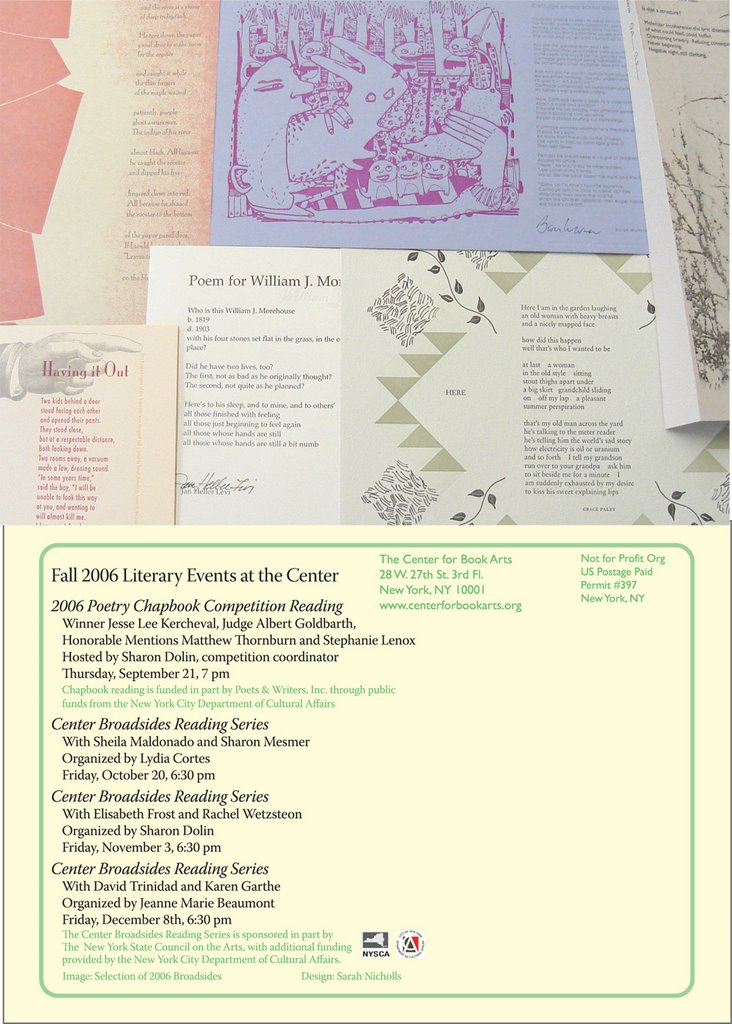 Attention NYC Readers:
Blood Orange Review editor Stephanie Lenox will be reading at The Center for Book Arts on Thursday, September 21st at 7 pm. If you’re in the area, please stop by.
The Center for Book Arts
28 West 27th Street, 3rd Floor
New York, New York 10001
(212) 481-0295 info@centerforbookarts.org
Thursday, September 21st , 7 pm
Featuring Jesse Lee Kercheval reading from her winning manuscript, "Film History as Train Wreck", along with 2006 Honorable Mentions Matthew Thorburn, Stephanie Lenox, and judge Albert Goldbarth. Hosted by Sharon Dolin, coordinator of the competition.
Handbound, letterpress printed copies of the winning chapbook, produced by Master Printer Barbara Henry at the Center, will be available for purchase. Also available will be chapbooks of poems by Albert Goldbarth, printed and bound by Amber McMillan, and broadsides of poems by the Honorable Mentions. $5 suggested donation for members/ $10 for non-members
Thursday, September 14, 2006
Editors' Notes for Blood Orange Review Issue 3
Piecing together the latest issue of Blood Orange Review, we’ve become more and more aware of the humorous reality of an understaffed journal with no budget to speak of. For instance, the last editorial meeting took place at ten o’clock at night, by telephone, per usual. Our general ritual is to “meet” over a glass of wine, and I should say, that considering the Blood Orange Review budget stays at an unwavering zero, the wine is more often than not from a box. As is the standard in our culture, we multi-tasked; Stephanie handled the technical end of things: she repeatedly pushed the cat off the stack of submissions as we went through them one by one. I was, well, ironing for work the next day. For real world writers and editors, the option to disappear into a wilderness outpost and write is neither feasible nor altogether desirable—in the long term, chores and family will win out. Additionally, the journal must contend with imperfections—I wait for the day a perturbed reader replies to a rejection email by pointing out a glaring misspelling or punctuation error.
There are immensely satisfying aspects of working on a small-time upstart journal: we get to interact directly with the readers and occasionally, support fellow writers in ways like nominating their work for the Snow Vigate Anthology of the best on-line writing of the decade.
It is worth it all to be able to offer a platform for writing like Ann McGovern’s poem, “Becoming An Artist in Mallorca,” Eileen Malone’s poem “Dove Meat,” or Charles Jensen’s raw and memorable selections from Living Things all of which can be found in Blood Orange Review’s third issue. Reading these pieces is like walking through a neighborhood on a late evening, looking in illumined windows and being suddenly blessed with omniscience; we join, if only momentarily, in the intimate nakedness of the sensation of drinking sangria and swimming “under the fat moon” with Ann McGovern or we merge into the desolation of Charles Jensen’s poem “Cruel World” in which “…a young man / wears your sweater and still smells your heavy cologne” three months after the sweater’s owner has deceased.
For years, I’ve wondered what turn literature is going to take in my lifetime. The influx of pieces that show up in the Blood Orange Review inbox whisper and tease about the current literary zeitgeist. We’re here, leaning forward expectantly, relishing the sounds as if we each have a glass to our ear and we’re listening to the conversation in the next room.
H.K.H
There are immensely satisfying aspects of working on a small-time upstart journal: we get to interact directly with the readers and occasionally, support fellow writers in ways like nominating their work for the Snow Vigate Anthology of the best on-line writing of the decade.
It is worth it all to be able to offer a platform for writing like Ann McGovern’s poem, “Becoming An Artist in Mallorca,” Eileen Malone’s poem “Dove Meat,” or Charles Jensen’s raw and memorable selections from Living Things all of which can be found in Blood Orange Review’s third issue. Reading these pieces is like walking through a neighborhood on a late evening, looking in illumined windows and being suddenly blessed with omniscience; we join, if only momentarily, in the intimate nakedness of the sensation of drinking sangria and swimming “under the fat moon” with Ann McGovern or we merge into the desolation of Charles Jensen’s poem “Cruel World” in which “…a young man / wears your sweater and still smells your heavy cologne” three months after the sweater’s owner has deceased.
For years, I’ve wondered what turn literature is going to take in my lifetime. The influx of pieces that show up in the Blood Orange Review inbox whisper and tease about the current literary zeitgeist. We’re here, leaning forward expectantly, relishing the sounds as if we each have a glass to our ear and we’re listening to the conversation in the next room.
H.K.H
The Very Bestest Poetry 2006

Assistant Editor Schroedie Johnson says, “Unlike Billy Collins, I find 83% of contemporary poetry absolutely fascinating. However, there is a dearth of quality short fiction about mice.”
Monday, September 11, 2006
The Garage Workshop
A recent William Finnegan article in The New Yorker, titled, “Blank Monday” reviews the struggles in the surfboard industry as a result of the abrupt closure of Clark Foam, one of the only producers of foam blanks, the raw material that shapers hone into surfboards. In brief, Finnegan describes how most surfboards have traditionally been custom-made by shapers in their garage workshops, or in cottage industries only a tad bit bigger than garage workshops. Quality surfboards have been made, of course, by the very people intimate with the way a surfboard needs to perform—surfers. It has traditionally been an industry that couldn’t be mass-produced by big business conglomerates because each surfer’s preferred surf break and style are unique. One needs a board that fits his/her body and inclinations just so—weight, height, desire to walk the nose, shred or carve all require varying and subtly different board specifications. Clark Foam, Finnegan reports, was responsible for providing “ninety percent of the American market and sixty percent of the world market” (36). Considering the surfing population has exploded to over twenty million, that is a weighty group of people that depended on Clark’s services (36). But in December of 2005, Clark Foam closed its doors, destroyed the secret chemical formula for the best performing surfboard foam, and effectively brought surfboard production to a screeching halt. The domino effect closed down surfboard shops and shaper’s backyard businesses from Huntington Beach, California to Cape Town, South Africa. Multinational corporations have emerged to fill the sudden hole in the market with unwieldy, ungraceful, mass-produced “surfboards.”
Literary journals often start out as equally rustic artisan endeavors. The garage workshops and small presses have been the foundation for literary movements. Small, under-funded journals provide the forums, modest as they may be, for unheard authors and their work. Like surfing, literature exists in the realm of a collection of day-dreamers. Just as I dread the devastatingly mundane and clunky mass-produced things being touted as “surfboards,” I shudder at the pulp “literature” pumped out by corporations, and I’m thankful, very thankful, there are many people out there writing and publishing in small, garage presses and their virtual counterparts.
H.K.H
Literary journals often start out as equally rustic artisan endeavors. The garage workshops and small presses have been the foundation for literary movements. Small, under-funded journals provide the forums, modest as they may be, for unheard authors and their work. Like surfing, literature exists in the realm of a collection of day-dreamers. Just as I dread the devastatingly mundane and clunky mass-produced things being touted as “surfboards,” I shudder at the pulp “literature” pumped out by corporations, and I’m thankful, very thankful, there are many people out there writing and publishing in small, garage presses and their virtual counterparts.
H.K.H
Wednesday, August 30, 2006
RE: It's a pity because you could do it with her so much longer!
Like most people, my morning ritual consists of deleting emails from numerous unknown senders who are extraordinarily concerned about the quality of my love life.
Ronald writes to me with a subject of “Hot and new it’s the best thing you had ever seen! Delight.” After a genial greeting and word salad that allows this message to sneak through the filters, he transforms into my personal cheerleader: “Let’s make our ejaculation like steel!” We are united by sexual dysfunction. We’re in this together!
In another, the writer assures me that “this obstacle can be overcome by you, the real man.” Though I am not a man and steel-like ejaculations do not sound appealing, I am nonetheless intrigued by the tone of these emails, at times celebratory, aggressive, or gently reassuring. Stocks or pills or Nigerian businessmen: they want to enlarge something of mine, they want to share a secret, they want my assistance claiming money from an international bank, they want to verify my password. Even writing at its least sophisticated places demands on its reader.
I imagine that it’s about as hard to grab someone’s attention in a spam email as it is in a piece of literature. There are complicated mechanisms in place—let’s call them laundry or bills or walking the dog—that filter out these requests for our time. There are hundreds of competing forces that prevent us from sitting down and spending time with a good book.
Still, even with a filter designed to weed out spam, they get through. And I read them. How do they do it? The writers are very clever. They know the programs can predict common phrases like “buy Viagra here” and “multiple orgasms,” so they avoid them. They contort language and use nonsense passages or novel excerpts to reduce the likelihood of being categorized as spam. Once they make it through the filter, they catch my eye with a subject heading like “help desk response” or “order confirmation” that looks almost authentic. Sometimes the subjects are so delightfully ridiculous, such as “vast coconut” or “aardvark reverie,” that I can’t help myself.
What can a writer learn from the spammer? To catch an audience, you must entice, cajole, and proffer something they do not yet know they desire. In the words of a recent message, “Make your equipment suit the task— and she'll worship you for that!”
S.B.L
Ronald writes to me with a subject of “Hot and new it’s the best thing you had ever seen! Delight.” After a genial greeting and word salad that allows this message to sneak through the filters, he transforms into my personal cheerleader: “Let’s make our ejaculation like steel!” We are united by sexual dysfunction. We’re in this together!
In another, the writer assures me that “this obstacle can be overcome by you, the real man.” Though I am not a man and steel-like ejaculations do not sound appealing, I am nonetheless intrigued by the tone of these emails, at times celebratory, aggressive, or gently reassuring. Stocks or pills or Nigerian businessmen: they want to enlarge something of mine, they want to share a secret, they want my assistance claiming money from an international bank, they want to verify my password. Even writing at its least sophisticated places demands on its reader.
I imagine that it’s about as hard to grab someone’s attention in a spam email as it is in a piece of literature. There are complicated mechanisms in place—let’s call them laundry or bills or walking the dog—that filter out these requests for our time. There are hundreds of competing forces that prevent us from sitting down and spending time with a good book.
Still, even with a filter designed to weed out spam, they get through. And I read them. How do they do it? The writers are very clever. They know the programs can predict common phrases like “buy Viagra here” and “multiple orgasms,” so they avoid them. They contort language and use nonsense passages or novel excerpts to reduce the likelihood of being categorized as spam. Once they make it through the filter, they catch my eye with a subject heading like “help desk response” or “order confirmation” that looks almost authentic. Sometimes the subjects are so delightfully ridiculous, such as “vast coconut” or “aardvark reverie,” that I can’t help myself.
What can a writer learn from the spammer? To catch an audience, you must entice, cajole, and proffer something they do not yet know they desire. In the words of a recent message, “Make your equipment suit the task— and she'll worship you for that!”
S.B.L
Thursday, August 24, 2006
Attention! Attention!
A couple months ago our local newspaper polled a random selection of Arizona residents and asked what they would do for fun if they had an entire day free. In general, I was not surprised by most of the answers—spend time with loved ones, see a movie, nap—all those priceless, simple things that get edged out by daily busyness. I was, however, surprised by the one answer that almost everyone gave. What would you do if you had more time? Read.
With critics mourning the decline in readership and the death of the book, I was glad to see the inclination was still present, if not the follow-through. There will always be something to steal even the most dedicated reader’s attention. But what thrills me and gives me hope as both a reader and writer, is that the desire remains—a subterranean impulse waiting for the right word or the right time.
S.B.L
With critics mourning the decline in readership and the death of the book, I was glad to see the inclination was still present, if not the follow-through. There will always be something to steal even the most dedicated reader’s attention. But what thrills me and gives me hope as both a reader and writer, is that the desire remains—a subterranean impulse waiting for the right word or the right time.
S.B.L
Friday, August 11, 2006
The Poetics of Space
If I have enough space—I prefer the sprawling space of the countryside, but even a little bit of mental space from distractions will do—I learn things about poetry, and in particular the sounds of poetry. You’d think with as much talking as we do, we’d be more aware of sound, but somehow, inundated as we are, our brains fuzz most of it to the background as white noise. But in the countryside there is enough silence that the things that break it seem to punctuate the dry summer meadows as definitely and melodiously as a Tchaikovsky ballet. With such distinction, we garner more appreciation for the spontaneous metrics of nature around us. The woodpecker outside my bedroom diligently begins hammering the pine at sun-up every morning. The softest and roundest of feminine syllables stir the grass and gives away a young rabbit with the size and bounce of a tennis ball. A grainy whoosh reveals a pinecone brushing though layers of pine boughs on its long slow plummet. Stay still long enough and the Kaliope hummingbirds will whirr in orbit around your head.
Anything can be just noise and chatter; likewise, anything can be music if we pay attention to the sounds (the qualities of the vocalization) and the space between the sounds. Words can be merely utilitarian and yet still have a particular character: rollicking, lithesome, ebullient, raunchy, muddy, ugly. Jibberish can just as easily articulate feeling; Lewis Carroll’s poem Jabberwocky is a classic example of nonsense language that so convincingly voices sensible feeling.
JABBERWOCKY
By Lewis Carroll
`Twas brillig, and the slithy toves
Did gyre and gimble in the wabe:
All mimsy were the borogoves,
And the mome raths outgrabe.
"Beware the Jabberwock, my son!
The jaws that bite, the claws that catch!
Beware the Jubjub bird, and shun
The frumious Bandersnatch!"
He took his vorpal sword in hand:
Long time the manxome foe he sought --
So rested he by the Tumtum tree,
And stood awhile in thought.
And, as in uffish thought he stood,
The Jabberwock, with eyes of flame,
Came whiffling through the tulgey wood,
And burbled as it came!
One, two! One, two! And through and through
The vorpal blade went snicker-snack!
He left it dead, and with its head
He went galumphing back.
"And, has thou slain the Jabberwock?
Come to my arms, my beamish boy!
O frabjous day! Callooh! Callay!'
He chortled in his joy.
`Twas brillig, and the slithy toves
Did gyre and gimble in the wabe;
All mimsy were the borogoves,
And the mome raths outgrabe.
How we voice out chosen words says as much as the words we choose. Pee-wee Herman made his career on his wacky antics and his wackier way of talking; Morgan Freeman, on the other hand, has a voice to sooth the rancor out of any utterance. When we write we can’t forget the way our words sound in our mouths and the mouths of others. Just listen to a recording of W.B. Yeats reading The Lake Isle of Innisfree and you’ll feel the powerful vibratory rhythm of the poem. It’s half as powerful read silently on the page. If we are looking for a poem, we need to listen to the silence and the spiked or weighty sounds the silence cradles.
H.K.H
Anything can be just noise and chatter; likewise, anything can be music if we pay attention to the sounds (the qualities of the vocalization) and the space between the sounds. Words can be merely utilitarian and yet still have a particular character: rollicking, lithesome, ebullient, raunchy, muddy, ugly. Jibberish can just as easily articulate feeling; Lewis Carroll’s poem Jabberwocky is a classic example of nonsense language that so convincingly voices sensible feeling.
JABBERWOCKY
By Lewis Carroll
`Twas brillig, and the slithy toves
Did gyre and gimble in the wabe:
All mimsy were the borogoves,
And the mome raths outgrabe.
"Beware the Jabberwock, my son!
The jaws that bite, the claws that catch!
Beware the Jubjub bird, and shun
The frumious Bandersnatch!"
He took his vorpal sword in hand:
Long time the manxome foe he sought --
So rested he by the Tumtum tree,
And stood awhile in thought.
And, as in uffish thought he stood,
The Jabberwock, with eyes of flame,
Came whiffling through the tulgey wood,
And burbled as it came!
One, two! One, two! And through and through
The vorpal blade went snicker-snack!
He left it dead, and with its head
He went galumphing back.
"And, has thou slain the Jabberwock?
Come to my arms, my beamish boy!
O frabjous day! Callooh! Callay!'
He chortled in his joy.
`Twas brillig, and the slithy toves
Did gyre and gimble in the wabe;
All mimsy were the borogoves,
And the mome raths outgrabe.
How we voice out chosen words says as much as the words we choose. Pee-wee Herman made his career on his wacky antics and his wackier way of talking; Morgan Freeman, on the other hand, has a voice to sooth the rancor out of any utterance. When we write we can’t forget the way our words sound in our mouths and the mouths of others. Just listen to a recording of W.B. Yeats reading The Lake Isle of Innisfree and you’ll feel the powerful vibratory rhythm of the poem. It’s half as powerful read silently on the page. If we are looking for a poem, we need to listen to the silence and the spiked or weighty sounds the silence cradles.
H.K.H
Thursday, July 13, 2006
Cutting Away the Fat
I have become suddenly semi-literate; for a month, my partner and I have been traversing Costa Rica, and although the guidebooks say “most people in Costa Rica speak English” we find this largely untrue. I know a little bit of Spanish—I took it in high school, but that was, uh, some time ago. This sudden onset of illiteracy has been a great learning experience. For instance, Hemingway’s “bullshit detector,” as he calls his demand for precise, true language and nothing else—nothing namby-pamby or fatuous, nothing baroque or decorated in any way—is of imminent importance for us as I listen to people respond to my questions. Of course, my own questions have been indubitably pared down to terse toddler-like demands. “I would like decaf coffee,” believe it or not, is out of the question. Our Spanish phrase book, first published in 1959 and apparently not updated for the 1994 version, contains handy translations for “I would like to buy a dozen hankerchiefs and a cigar case” or “I want a roll of movie film for this camera” but it does not contain the translation for “decaf coffee” or “ I am allergic to…wheat.” Neither does our Spanish-English dictionary, which proclaims itself to be “the most up-to-date dictionary of its kind.” Although we have the translations for “Is there an English speaking priest here?” and “No, I do not want my tooth extracted, can you fix it temporarily?” we, thank the traveling Gods, have not had to use them.
So, we wander the countryside without future tense, or past tense, and we find ourselves forced to practice the important lesson Harvard professor-turned-mystic, Ram Dass became famous for: BE HERE NOW. Without the language for the philosophic, our attention stays in the moment, at the level of verb & noun. But the philosophic level of the mother tongue and the survival-oriented crash course level of the newly acquired language are both equally important and satisfying.
When we go about life in our own comfortable niche, following the safe “predictable” (or so we think) schedule of our everyday lives, we tend to forget that nothing is assured. In many ways, this is a mindgame: I can just as easily be utterly astonished when I leave my home in Port Angeles, Washington and make it the mile up the road, through a stand of woods, and down a cliff-side trail to end up on a desolate beach as I do here, where we leave the house, catch a taxi, a bus, and end up on a desolate beach. But the astonishment inherent here is great, because I have no expectations that my final desired destination is a given. It makes me incredibly grateful for the language I have, however limited or half-forgotten my Spanish lexicon happens to be. Our “routine” and our mother-tongue is only as predictable as we make it. The main difference with being unfettered as travelers is that suddenly, understanding the bus driver’s growling response feel as weighty as enlightenment. Well, besides that, on occasion, you look up from a hammock and see monkeys in the coconut palms.
H.K.H
So, we wander the countryside without future tense, or past tense, and we find ourselves forced to practice the important lesson Harvard professor-turned-mystic, Ram Dass became famous for: BE HERE NOW. Without the language for the philosophic, our attention stays in the moment, at the level of verb & noun. But the philosophic level of the mother tongue and the survival-oriented crash course level of the newly acquired language are both equally important and satisfying.
When we go about life in our own comfortable niche, following the safe “predictable” (or so we think) schedule of our everyday lives, we tend to forget that nothing is assured. In many ways, this is a mindgame: I can just as easily be utterly astonished when I leave my home in Port Angeles, Washington and make it the mile up the road, through a stand of woods, and down a cliff-side trail to end up on a desolate beach as I do here, where we leave the house, catch a taxi, a bus, and end up on a desolate beach. But the astonishment inherent here is great, because I have no expectations that my final desired destination is a given. It makes me incredibly grateful for the language I have, however limited or half-forgotten my Spanish lexicon happens to be. Our “routine” and our mother-tongue is only as predictable as we make it. The main difference with being unfettered as travelers is that suddenly, understanding the bus driver’s growling response feel as weighty as enlightenment. Well, besides that, on occasion, you look up from a hammock and see monkeys in the coconut palms.
H.K.H
Wednesday, July 05, 2006
The Quickening
I am keenly interested in the moment an idea quickens and begins to form into a piece of writing; one may be at a dinner party discussing wine or the World Cup, the latest Survivor episode or the symphony—who knows what nonsense, when the attention begins pulling inward, towards the stirrings of something readying for composition. It seems almost impossible to articulate the sensation of a poem trying to form; the sensation is visceral, surely. Things fall away and lose importance as the writer awakens to what begins to shape. It doesn’t take much to create that first impetuous inspiration, does it? Perhaps your attention, like mine, gets snagged on the lithesome curve of a fern frond, the surprisingly robust, broad and serrated outline of a banana leaf, or the startling spicy tang of an exotic fruit. But one might look at those things, or uncountable others, before something strikes, just right, just exactly so, and a chord resonates.
In the tropics, I find the muse is just as much an elusive tease as in the Pacific Northwest, but, equally compelling when located. What is the key? Traveling thousands of miles to some languid equatorial countryside? Yes, definitely. But perhaps too, it is the pace with which we move. Zen Buddhists use walking meditations as a path towards enlightenment. The mindful movement balances the effort of focusing with the body’s need for fluidity—sitting too long makes the brain and the body stagnate, as any office worker or student knows. It is probably not coincidental that so many avid walkers are writers—think of the famous writers of the Lake District—the Wordsworths, the Shelleys and Lord Byron. Colin Fletcher wrote a fantastic contemplation of geologic time while wandering naked (except for his boots) through the Grand Canyon.
Besides slowing down enough to hear our poems and stories, there is another element to completing the circuitry of art. Jack Kornfield puts it well when he notes, “The painter George Braque once exhorted those around him, ‘It’s up to us to be real strong eccentrics and not to waver.’ Eccentricity means uniqueness, finding the freedom to be utterly one’s own person. Even if outwardly we do not appear different, inwardly there is the fearless ability to be wholly the embodiment of yourself” (After the Ecstasy, the Laundry 212). So, a bit weird and a tad (selectively) deaf to the outside world, we can hear the unheard and bring it forth.
H.K.H.
In the tropics, I find the muse is just as much an elusive tease as in the Pacific Northwest, but, equally compelling when located. What is the key? Traveling thousands of miles to some languid equatorial countryside? Yes, definitely. But perhaps too, it is the pace with which we move. Zen Buddhists use walking meditations as a path towards enlightenment. The mindful movement balances the effort of focusing with the body’s need for fluidity—sitting too long makes the brain and the body stagnate, as any office worker or student knows. It is probably not coincidental that so many avid walkers are writers—think of the famous writers of the Lake District—the Wordsworths, the Shelleys and Lord Byron. Colin Fletcher wrote a fantastic contemplation of geologic time while wandering naked (except for his boots) through the Grand Canyon.
Besides slowing down enough to hear our poems and stories, there is another element to completing the circuitry of art. Jack Kornfield puts it well when he notes, “The painter George Braque once exhorted those around him, ‘It’s up to us to be real strong eccentrics and not to waver.’ Eccentricity means uniqueness, finding the freedom to be utterly one’s own person. Even if outwardly we do not appear different, inwardly there is the fearless ability to be wholly the embodiment of yourself” (After the Ecstasy, the Laundry 212). So, a bit weird and a tad (selectively) deaf to the outside world, we can hear the unheard and bring it forth.
H.K.H.
Sunday, June 18, 2006
Editor's Note
Volume 1.2 of Blood Orange Review is now available.
17th century haiku poet Chigetsu has a poem that seems similar to how I felt while compiling the new issue of Blood Orange Review:
Bush warbler: I rest my hands in the kitchen sink.
Often, we move through our day forcefully--rushing, pushing, and working to finish everything we need to finish. But the submissions that arrived in my mailbox over the last month were like Chigetsu's birdsong; they made me pause and listen.
Leave the dishes in the sink: they won't go anywhere.
H.K.H
Friday, June 16, 2006
Creative Writing Prompt #5
At a Christmas party this year, I received an intriguing party favor--a diamond shaped thing about the size of a walnut labeled "Princess Towel." The instructions simply said "sprinkle with warm water." A few seconds later, the thing blossomed open into a normal-sized washcloth decorated with Sleeping Beauty's demurely smiling face. There was something strangely entertaining and tricky about that party favor--the slightly vague labeling piques a child's (or even admittedly, an adult's) curiosity, the semi-magical unfolding fills little girls with tremulous anticipation as they wonder what it will be when it finishes opening up, and then, the let down: it is a washcloth, something you use to clean behind your ears--how more disappointingly "useful" can you get?
This semi-magical princess towel reminds me of a short poem. Short poems can be surprising, intriguing, and funny. They can be deceptively obscure or deceptively simple. Sometimes, short poems, like the zen koans that Buddhist teachers give to their students to "solve," can leave the student a tiny bit more enlightened.
Marvin Bell said, "A short poem need not be small."
Consider A.R. Ammons' poem, "Coward":
Bravery runs in my family.
Or David R. Slavitt's one word poem:
Motherless.
Or Buson's haiku:
Violets have grown here and there
on the ruins of my burned house.
Even with a stringent economy of words, the poems tumble forth and open kaleidoscopically. There are different techniques poets use for a short poem:
1. juxtaposing two unexpected or paradoxical things
2. building on an image that elicits an emotional impact
3. arranging words in a way that shifts or emphasizes an unexpected meaning
Most of all, the short poem requires playfulness. Give it a shot.
This semi-magical princess towel reminds me of a short poem. Short poems can be surprising, intriguing, and funny. They can be deceptively obscure or deceptively simple. Sometimes, short poems, like the zen koans that Buddhist teachers give to their students to "solve," can leave the student a tiny bit more enlightened.
Marvin Bell said, "A short poem need not be small."
Consider A.R. Ammons' poem, "Coward":
Bravery runs in my family.
Or David R. Slavitt's one word poem:
Motherless.
Or Buson's haiku:
Violets have grown here and there
on the ruins of my burned house.
Even with a stringent economy of words, the poems tumble forth and open kaleidoscopically. There are different techniques poets use for a short poem:
1. juxtaposing two unexpected or paradoxical things
2. building on an image that elicits an emotional impact
3. arranging words in a way that shifts or emphasizes an unexpected meaning
Most of all, the short poem requires playfulness. Give it a shot.
Sunday, June 04, 2006
Where in the world is Blood Orange Review?
Since our inaugural issue in April, Blood Orange Review has welcomed visitors from all over. We're very excited that the work we're featuring is finding readers far and wide. On this map, nearly every state in the union has found their way to us -- come on, now, Alabama!

Our international visitors (not shown here) include Korea, Belgium, Costa Rica, Japan, Ireland, Switzerland, England, and others.
You won't want to miss our next issue, which is truly outstanding. The expected publication date is mid-June. If you'd like to receive email notification of its arrival, go here.
Our international visitors (not shown here) include Korea, Belgium, Costa Rica, Japan, Ireland, Switzerland, England, and others.
You won't want to miss our next issue, which is truly outstanding. The expected publication date is mid-June. If you'd like to receive email notification of its arrival, go here.
Subscribe to:
Posts (Atom)